Connecting Bodhgaya, Bengal and Odisha
Most Buddhist pilgrimage planning in India starts and stops in Bihar – Bodhgaya, Rajgir, Nalanda, Sarnath just across the border in Uttar Pradesh. That’s for good reason: Bodhgaya is where the Buddha attained enlightenment, and no circuit should ever try to compete with that significance. But swing east from Bihar, and eastern India holds a second, less-visited Buddhist landscape – one running through West Bengal’s Mogalmari and into Odisha’s Diamond Triangle – that most pilgrimage itineraries simply skip because nobody has laid out how the pieces connect.
This article does that. We’re proposing a circuit – clearly labeled as MBA’s proposal for modern travelers, not a reconstruction of an ancient fixed pilgrim route – built on real geography, real distances, and real historical logic.
The Historical Logic Behind the Route
Here’s what’s genuinely established, not just convenient for tourism marketing: archaeological and literary evidence indicates that Mogalmari’s monastery did not develop in isolation. A trade route likely ran near the site connecting the ancient port of Tamralipta – near modern Tamluk, roughly two hours from Mogalmari – with Buddhist monastic centers across the Suvarnarekha River in Odisha, including Jayrampur, Basta, Khiching, Baleswar, and the Pushpagiri complex that includes today’s Lalitgiri. This is documented by the archaeologists who excavated Mogalmari itself, not assumed for marketing purposes.
Separately, and independently, Odisha’s Diamond Triangle – Lalitgiri, Udayagiri and Ratnagiri – has long scholarly association with Pushpagiri, a major center of Buddhist learning referenced in Xuanzang’s 7th-century travel accounts, comparable in stature to Nalanda and Taxila.
So the honest picture is this: two real historical threads – a Bengal-to-Odisha trade and monastic corridor, and Bihar’s status as Buddhism’s point of origin – sit geographically close enough on the modern map to be connected into one meaningful, evidence-respecting journey. We are not claiming ancient pilgrims walked a fixed “Bodhgaya-Mogalmari-Odisha” route as a single named circuit. We are pointing out that the three regions were part of the same broader Buddhist world, and that connecting them today makes both historical and practical sense.
Anchor One: Bodhgaya, Bihar - Where the Story Begins
Bodhgaya needs no positioning from Mogalmari – it stands on its own as the most sacred site in world Buddhism, the place where Siddhartha Gautama attained enlightenment under the Bodhi Tree. The Mahabodhi Temple Complex here is a UNESCO World Heritage Site, and international monasteries from Thailand, Japan, Tibet, Bhutan, Sri Lanka and Myanmar all maintain a presence in the town, making it as much a living, international Buddhist community as an archaeological monument.
For circuit purposes, Bodhgaya is the spiritual anchor and natural starting or ending point – a pilgrim who has come this far for Bodhgaya has already made the larger journey; extending it east is a comparatively small additional step.
Anchor Two: Mogalmari, West Bengal - The Connector
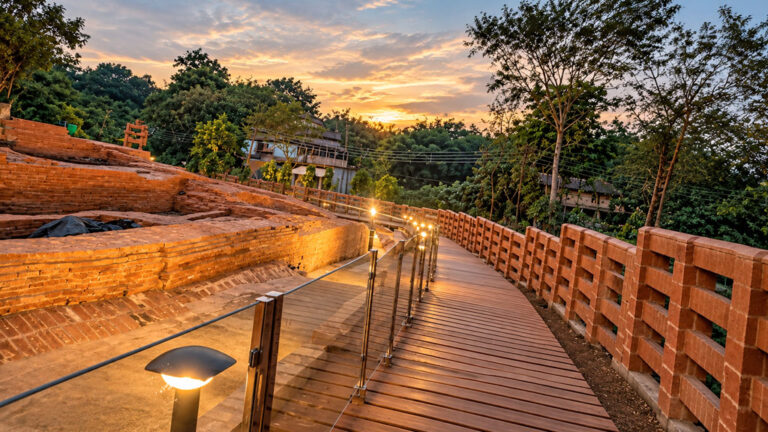
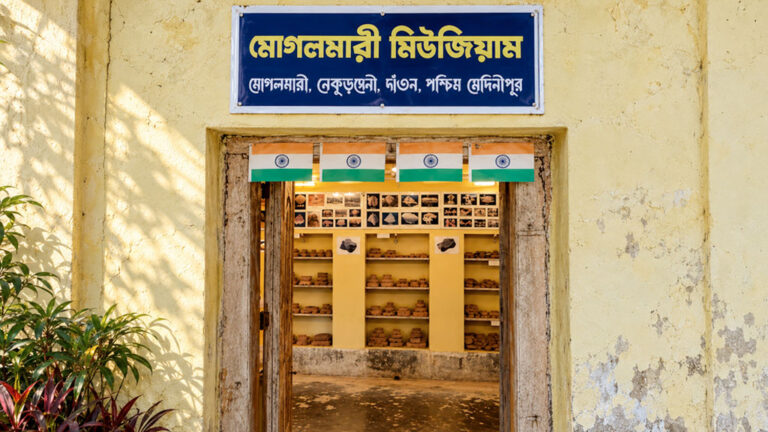
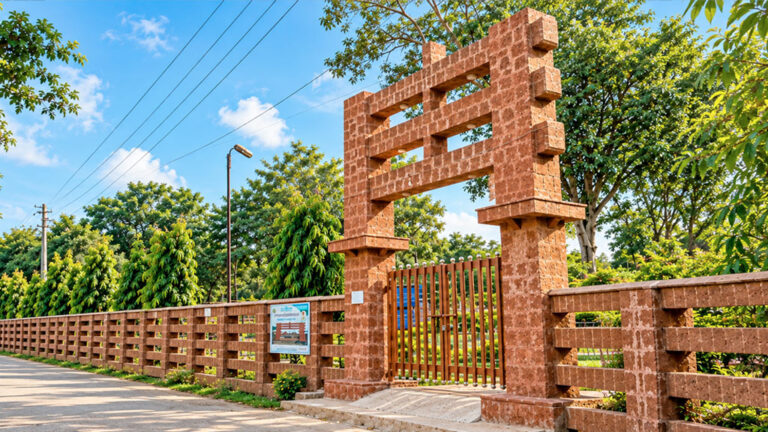
Mogalmari’s role in this circuit is not to rival Bodhgaya’s sanctity or Odisha’s scale – it’s to be the connective link that most itineraries currently miss entirely. It sits directly on the Kolkata-Bhubaneswar highway corridor (NH16), close to Dantan, meaning a traveler moving between Bengal and Odisha by road passes within a short detour of the site without any major deviation.
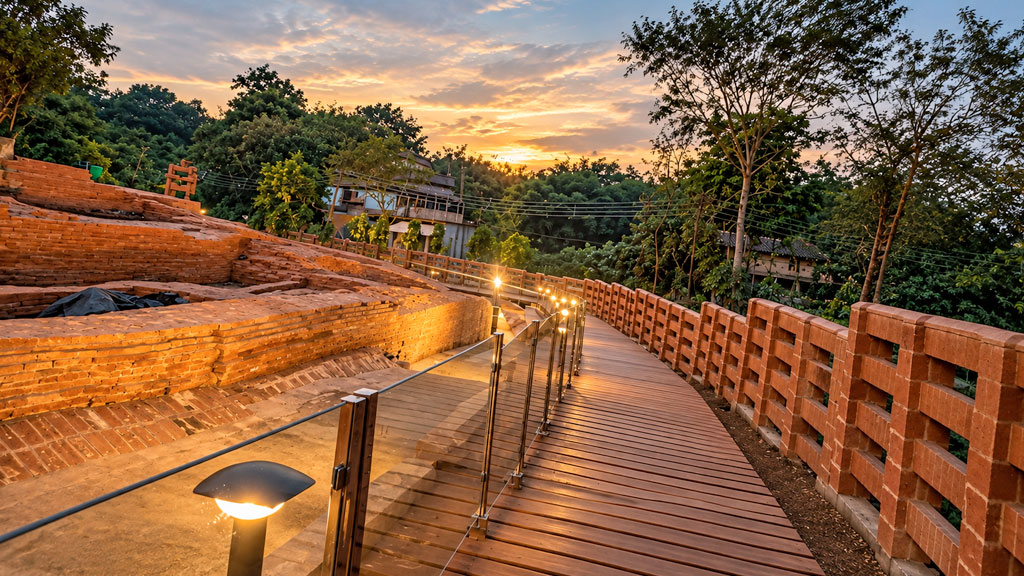
What Mogalmari adds to the circuit is substance most travelers don’t expect from a “detour” stop: the largest excavated Buddhist monastic complex in West Bengal, two named monasteries in one compound (a configuration the excavation team describes as unique in eastern India), decorative stucco work comparable in style to Nalanda, and a steady stream of new finds – most recently over 40 bronze artifacts in a single 2022 excavation day. For a pilgrim who has just come from the birthplace of Buddhism, Mogalmari offers something different: a tangible sense of how Buddhism actually lived and functioned as an institution in Bengal for six centuries.
Anchor Three: Odisha's Diamond Triangle and Dhauli - The Diversity Showcase
Roughly 90 to 100 km northeast of Bhubaneswar lies what’s popularly called the Diamond Triangle – Lalitgiri, Udayagiri and Ratnagiri, three closely spaced hill complexes (Udayagiri and Ratnagiri sit about 11 km apart, both within a few kilometers of Lalitgiri). Together they represent centuries of Buddhist architectural evolution: Lalitgiri’s Mahastupa dates to the 1st century BCE and is associated with relics said to include the Buddha’s tooth; Ratnagiri’s Monastery 1 has been described by scholars as among the finest surviving examples of carved stone decoration in India; Udayagiri, the largest of the three, revealed its ancient name – Madhavapura Mahavihara – through recent excavation.
Closer to Bhubaneswar itself, Dhauli marks the site traditionally associated with Emperor Ashoka’s transformation after the Kalinga war – the moment that, by tradition, turned an empire-builder into Buddhism’s most consequential royal patron. Together, the Odisha leg of the circuit shows a pilgrim the sheer diversity of eastern Indian Buddhism: Hinayana, Mahayana and Vajrayana traditions all represented within a single, compact touring region.
Putting the Route Together
Here is how the three anchors connect on the ground, using real road and rail distances:
- Kolkata to Bodhgaya: approximately 470-495 km by road (roughly 8-9 hours), or about 7-8 hours by train via Gaya Junction, or roughly 1 hour 20 minutes by air (Kolkata-Gaya).
- Kolkata to Mogalmari (Dantan): approximately 170-190 km along NH16, roughly 3.5-4 hours by road – Mogalmari sits directly beside this highway, just past Nekurseni.
- Mogalmari to Bhubaneswar: roughly 250-260 km further down the same NH16 corridor, continuing through Balasore, Bhadrak and Cuttack.
- Bhubaneswar to the Diamond Triangle: approximately 90-100 km northeast, with Udayagiri, Ratnagiri and Lalitgiri all within a short drive of one another once there.
A workable structure for a serious pilgrim or heritage traveler: begin in Bodhgaya (2-3 days, covering the Mahabodhi Temple, Sujata Village, and the international monasteries), travel to Kolkata as a transit and gateway city (allowing a day for the city’s own Buddhist connections, including the Indian Museum’s Buddhist art collection), continue by road to Mogalmari for a half-day to full-day visit, and finish with 2-3 days across Bhubaneswar, Dhauli, and the Diamond Triangle. Total duration: roughly 8 to 10 days, comfortably paced rather than rushed – this is a heritage journey, not a checklist.
This routing also respects a basic rule of good circuit design: it doesn’t backtrack. Bodhgaya to Kolkata to Mogalmari to Bhubaneswar to the Diamond Triangle runs in essentially one direction, north to south, along a real transport corridor, rather than zig-zagging between regions to force in extra stops.
Why This Circuit Is Worth Building Now
Eastern India’s Buddhist heritage is currently split across three separate tourism identities – Bihar’s pilgrim circuit, Bengal’s emerging archaeological sites, and Odisha’s well-established Diamond Triangle – each marketed on its own, to largely the same international audience of Buddhist travelers, scholars and monastic visitors. None of these regions loses anything by being connected; if anything, each becomes a stronger draw as part of a longer, more complete story of how Buddhism moved and took root across eastern India.
For Mogalmari specifically, inclusion in this circuit is not a claim to equal Bodhgaya’s stature – it is a realistic, geographically honest way to be discovered by travelers who are already making this journey, and who would welcome a meaningful stop between two established destinations rather than a long stretch of highway with nothing to see.
This is the circuit MBA is proposing: grounded in real trade-route history, real modern infrastructure, and real distances – not manufactured significance, but genuine geographic and historical logic put to good use.
Sources consulted: Mogalmari excavation reports (Asok Datta and team); Odisha Tourism and ASI documentation on Lalitgiri, Udayagiri and Ratnagiri; road-route and distance data from standard travel-distance services; and heritage reporting on Bodhgaya, Dhauli and the Diamond Triangle. Travel times, road conditions, and transport schedules should be reconfirmed closer to the travel date, as these change over time.